Nissan Silvia 240RS
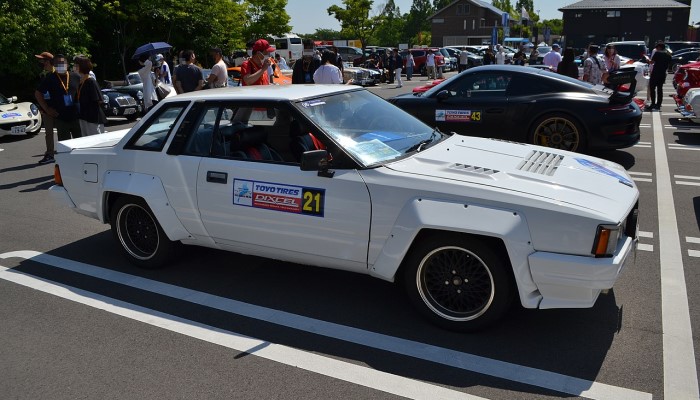
Extremely Straight and Unusual Appearance
Another virtually unknown car from the much-missed Group B of the World Rally Championship (WRC) was the Nissan Silvia 240RS. Although it failed to achieve any significant results, that doesn't mean the effort the Japanese brand made to make it competitive is no less interesting.
More than that, the 240RS is a historic and charismatic car simply because it took part in a golden era of Rallying and especially because of its participation in the famous Group B.
The Nissan Silvia in the 240RS version of Group B had an extremely straight and unusual appearance, quite atypical for the Japanese. This car was such a "square" design that this was even reflected in the precision of the dimensions, with all the numbers being quite exact and round, that is, the car was exactly 4,330 mm (170 in) long, 1,800 mm (71 in) wide, 1,310 mm (52 in) height and 2,400 mm (94 in) wheelbase.

It was for all of these reasons that this Nissan was a strange sight to those who saw it. Not only because of its beauty and contemporary design, but also because it was probably the best rally car in terms of performance ever created by Datsun/Nissan. And it was the car chosen by the brand for Group B homologation.
It wasn't exactly a "true" Group B car, and it didn't have any superlative tricks compared to the competition. It was a very simple car, without 4-wheel drive and without a turbo.
You might think that it was a conventional and uninteresting car, that it was a car without qualities, that it was in the same category as other cars like the Ford Escort RS, the Fiat 131 or even the Opel Ascona 400, but that's not quite true.
Nissan's Scenario for the 240RS
It was a conventional car, okay, just with rear-wheel drive, and it even had a 2.4L (143 ci) engine, like the Ascona 400. And so, with its debut in 1983, the car should have been forgotten in time as if it were an obsolete part.
And it probably was, but while many rivals believed in the success of 4WD, especially Audi, to win in all conditions and terrains like the Safari Rally, Nissan believed in another scenario, and was in total disagreement with this idea.
The Safari Rally has always been the event where Nissan has had strong confidence in a good result, and where the Silvia 240RS had the prospect of taking the place of success that once belonged to the Datsun 160J Violet.
To do this, Nissan had a recipe for winning on the African continent. The car had to be simple and robust without the need for 4WD. And in fact during the period, and it was Group B, no 4×4 car ever won the Safari Rally. Nissan actually had some logic in its arguments, but…
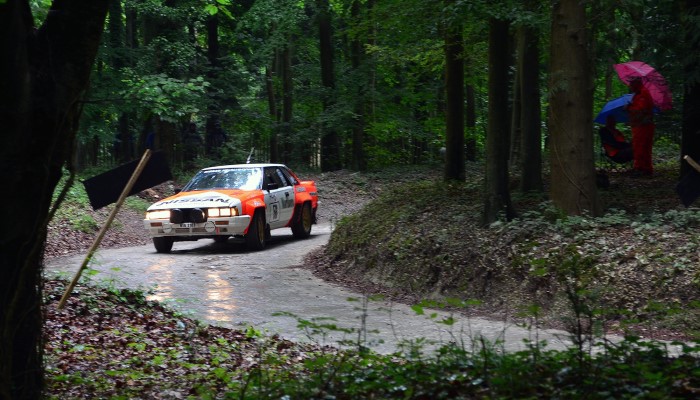
Photo: Nissan 240RS" by Neil
For the 240RS to be Datsun/Nissan's most competitive rally car, it had to achieve better results than those actually seen. With the Safari Rally being Nissan’s top priority, it may come as a surprise that Timo Salonen achieved an excellent 2nd place in the 1983 Rally New Zealand, a result that not even the Nissan Sunny GTI-R (4x4) could even dream of in its wildest imagination.
A similar surprise was when driver Tony Pond even managed to take 3rd place in the 1983 Tour de Corse asphalt rally, but several minor problems arose in his 240RS and it eventually dropped to sixth place, which is still remarkable.
Unsolvable Problem
The 240RS was elegantly competitive for what it was designed for, there should be no doubt about that, but despite its simple design, the car suffered from numerous reliability problems. Or, to put it in clear and objective perspective, the 240RS only had one problem.
For some (unknown!) reason, the 2.4-liter engine destroyed valve trains as if it were a natural thing. Nissan never managed to solve this problem. One of the many examples of this happened in the 1983 Safari Rally.
While Shekhar Mehta and Mike Kirkland had to abandon the rally early due to broken camshafts, Timo Salonen led for almost 2 hours, only to suffer the same problem in the last section, handing the victory to Ari Vatanen's Opel on a silver platter.
Specifications and Performance
Still, the Nissan Silvia 240RS was one of the last extremely conventional cars and, despite its Group B homologation, it was quite simple, quite cheap, with decent technology standards, and with a 2.4-liter (143 ci) engine with 237 horsepower that was more powerful than most comparable options.
Engine Specs
| Engine Type | Inline 4 DOHC |
| Layout | Front engine, RWD |
| Displacement | 143 ci (2,340 cc) |
| Torque | 235 Nm |
| Power | 237 hp |
| Power/Weight | 215 hp / Tone |
Performance
| 0-60 mph (0-96 kph) | 6,1 s |
| 0-100 mph (0-160 kph) | 13,1 s |
| 1/4 mile | 14,4 s |
| Top Speed | 128 mph (205 kph) |
Individuals loved it and it's no surprise to find one now and then, still participating in national classic rallies.
Is it Available on the Market?
Judging by the data from classic.com, it can be said that the 240RS is an extremely rare car on the market. This is normal considering the number of models produced (200) for homologation.
In the last five years, two copies have been sold: the first in October 2021 (Paris, FRA) for almost $250,000, and the second in August 2023 for a little over $110,000 (Silverstone, GBR). So, serious sums are involved...

Unique Car Zone Team
A group of several fans of everything that moves on four wheels, a few article creators, a couple of marketing strategists, designers, web developers, and lots of coffee.